
October arrives. The leaves darken, the vines are stripped bare row after row, and in most European estates, the vats are already full. The harvest is finished, or nearly so. But while the vine enters its winter rest, a few winemakers wait still, eyes fixed on the thermometer or on bunches covered with a veil of golden mold. The end of the wine season is rarely a single moment: it is a long, technical process that begins before the first cuts and sometimes extends until the first frosts.
When to harvest?
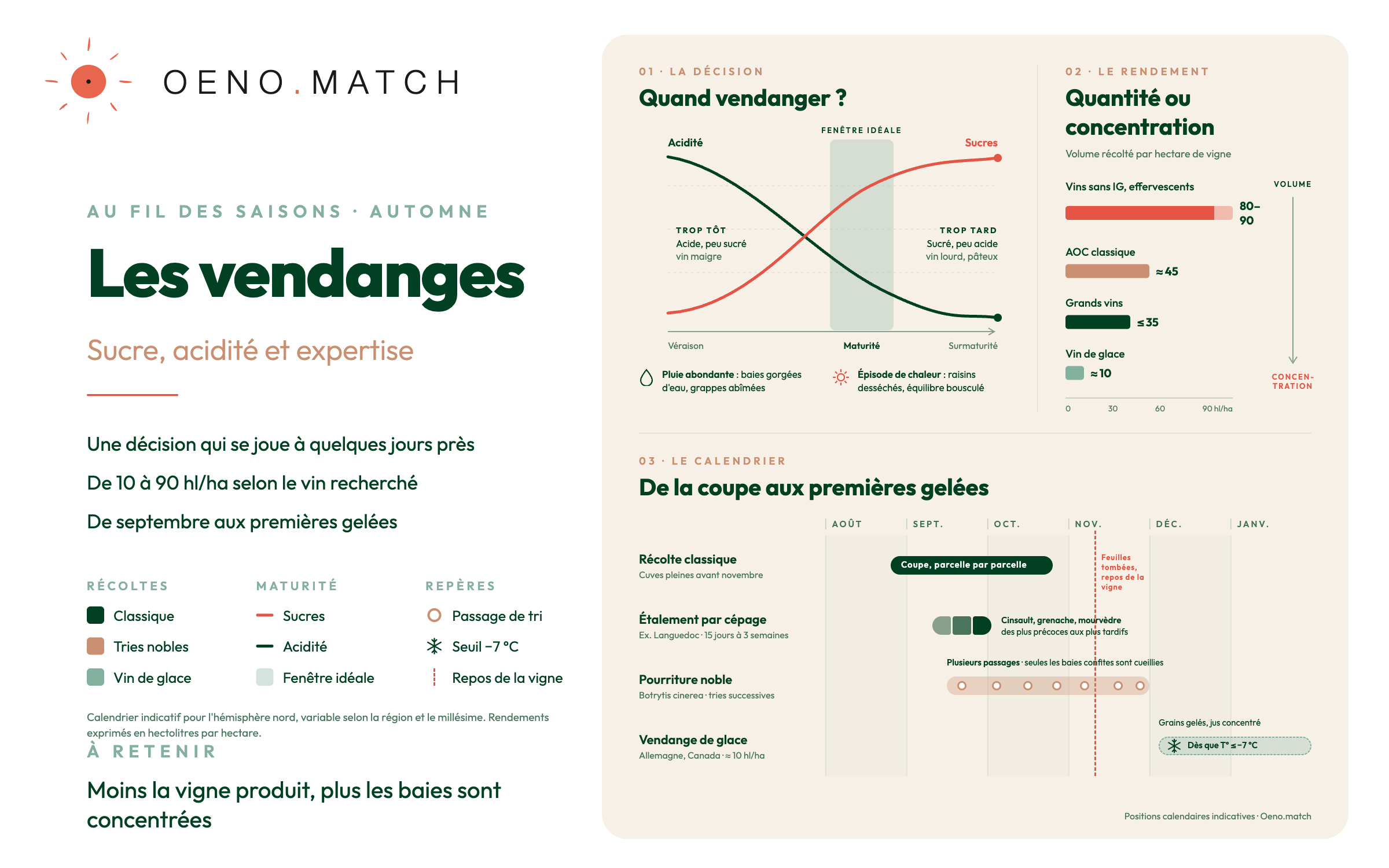
The decision to harvest depends on the grape variety, the terroir, the altitude, the exposure of each plot — and of course the weather. Harvesting too early yields grapes lacking in sugars and acidity, which will produce a thin and unexpressive wine. Too late, the grapes lose acidity, become heavy and pasty. The winemaker constantly juggles these parameters, and must sometimes adapt his decision within days if heavy rain or a heat wave suddenly changes the state of the bunches.
In a region like Languedoc, the grape varieties do not ripen simultaneously. Grenache, mourvèdre or cinsault may require staggered harvesting over two to three weeks. The earliest-ripening varieties are picked first, plot by plot, then the late ones.
Yields: the tension between quantity and quality
Yield measures the quantity of grapes harvested per hectare. It is one of the most closely monitored indicators in the wine world, as it directly conditions the concentration of the juice. One objective dominates: produce a lot, or concentrate? The two are rarely compatible.
A typical AOC wine averages around 45 hectoliters per hectare. Table wines and sparkling wines can reach 80 to 90 hl/ha, while great wines rarely exceed 35 hl/ha. These figures are not inconsistent: the less the vine produces, the more it concentrates its resources in each berry.
Late harvest: patience as a tool
Reserved for sweet wines, late harvests are technically complex. The best results come from grapes affected by noble rot, a fungus called Botrytis cinerea. It colonizes the berries in a paradoxically beneficial way: by drying out the grape, it concentrates sugars and aromas spectacularly.
The fungus does not establish itself uniformly. It progresses bunch by bunch, and the winemaker must pass through the rows several times — from September to late November depending on the year — to select only the perfect berries, those that have reached a form of concentrated dried grape. A logic of patient extraction, the opposite of mechanical harvesting. But let us reserve a specific article for this unique winemaking method.
Ice harvest: the extreme of the spectrum
At the other end of the calendar and climatic conditions, ice harvests obey a radically different logic. To produce this wine, the winemaker waits for temperatures to drop below -7 °C. A layer of frost then surrounds the grape grains, which become even more concentrated in sugars — the water being partly frozen, only the sweet and dense juice flows during pressing.
The work is exhausting, yields extremely low, around 10 hl/ha, and financial losses considerable if the harvest goes wrong. These constraints explain the high price of bottles. This technique remains the preserve of regions where winter frost is regular and sufficiently intense: Germany and Canada are its most emblematic producers. Climate change increasingly undermines these conditions, making each vintage of ice wine a little rarer and more uncertain than the last.