
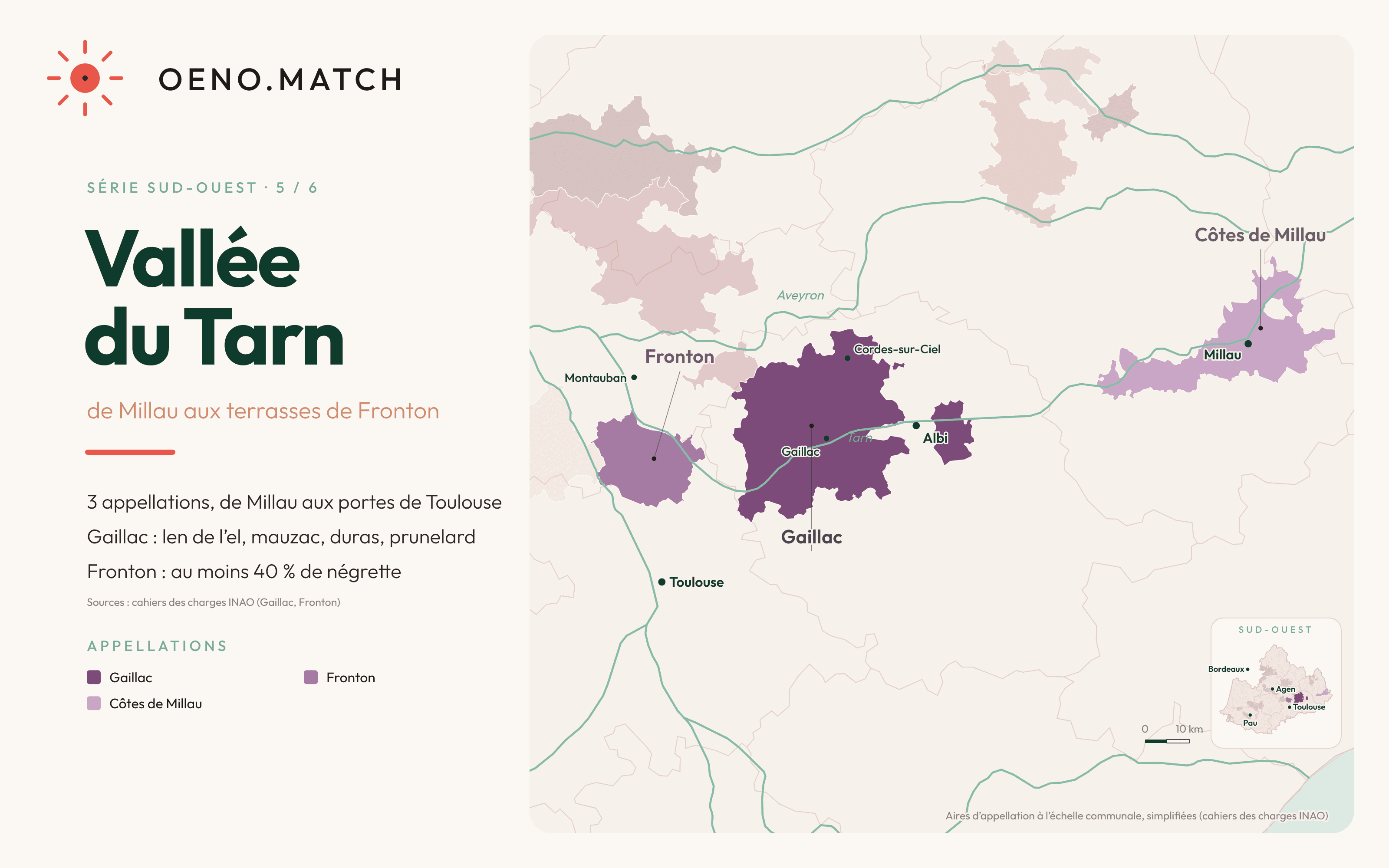
The Tarn flows through vineyards that have preserved grape varieties cultivated almost nowhere else. From Millau to the terraces of Fronton, this article tells the story of those who defended them.

At Cahuzac-sur-Vère, Robert Plageoles searched old vines for plants that no one wanted anymore. Ondenc had almost disappeared, prunelard too. Mauzac survived in several forms, but few still knew all its nuances. Plageoles replanted and vinified them. He also revived a mauzac voile wine, aged under a veil of yeasts. His son Bernard took over at Domaine Plageoles and continues this conservation work. The labels highlight the names of the grape varieties, like an identity card. Visitors leave with a lesson in ampelography in bottles.
This is the thread running along the Tarn: vineyards that held onto their own varieties.
Gaillac, one of the oldest vineyards of Gaul
At Montans, a few kilometers from Gaillac, excavations uncovered Gallo-Roman pottery workshops. Wine amphorae were manufactured there from Antiquity. An archaeosite now presents the remains.
The Gaillac area extends on either side of the Tarn, around the city, in Tarn. Its regulations translate this history into grape varieties. In white, len de l'el, whose Occitan name means "far from the eye," shares space with mauzac and muscadelle. In red, duras, fer servadou and prunelard form the base, and syrah is added. This combination exists only here.
The appellation also recognizes a wide palette of styles. Gaillac produces dry and sweet wines, late harvests, a primeur and an ancestral method. For the latter, fermentation is completed in the bottle, without the addition of liqueur. The wine thus retains the taste of the grape. It is an older way of making bubbles than the traditional méthode champenoise with liqueur.
Patrice Lescarret runs Domaine Causse Marines, at Vieux. He works with uncommon Gaillac grape varieties, plot by plot. He shows another way of reading the appellation, on the margins of the most widespread styles.
Négrette, sovereign of Fronton
Further west, Fronton occupies the ancient terraces between Tarn and Garonne, north of Toulouse. Vines grow there on gravel and boulbènes. The appellation builds its identity on one grape variety: négrette. The regulations require it to represent at least 40% of the blend.
Négrette is recognized by its aromas of violet and licorice, sometimes with a peppery note. It produces supple reds and rosés, to be drunk on the fruit. A Fronton is served slightly chilled, with South-West cuisine without heaviness.
The Ribes family runs Domaine Le Roc, at Fronton. They made négrette the center of their work, in red as in rosé. Their cuvées are among those that carried the Fronton name beyond its zone.
Côtes de Millau, in the gorges
Moving up the Tarn toward its source, the landscape changes. The gorges enclose the river between the Grands Causses, in Aveyron. It is there, on terraces of approximately 60 hectares, that the Côtes de Millau appellation extends. It is one of the smallest in the South-West.
The Cave des Vignerons des Gorges du Tarn, at Aguessac, is its main player. It brings together the winemakers of a sector where each terrace demands hand work. This vineyard stands at the border between the Massif Central and the Midi, and its wines bear the trace of this position. They are best tasted on site, after a walk in the gorges.
What the valley has already proven
The Tarn does not only connect three appellations. It connects gestures. Plageoles replants ondenc and prunelard. Lescarret preserves uncommon Gaillac grape varieties. The Ribes defend négrette. The winemakers of Aguessac maintain their terraces in the gorges. None of these gestures has been spectacular. Each has demanded years, and often the choice to produce less in order to keep a grape variety that the market ignored.
It is often said that these old grape varieties could better withstand the changing climate. No published source allows us to assert this here, and the question remains open. It deserves to be posed to researchers and winemakers themselves, vintage after vintage. What the valley has already shown is that one can build a wine identity without imitating anyone.