
In February 1956, an extreme frost destroyed much of the old vines in Cahors. Some families abandoned their vineyards, while others replanted and rebuilt the vineyard on the terraces of the valley.

The Baldès family at Clos Triguedina, and the Verhaeghe family, who arrived in the late 1950s at Château du Cèdre, were among those who rebuilt, plot by plot. This reconstruction led to the AOC, obtained in 1971. A sector almost wiped out by frost regained a framework, rules, and a name to defend.
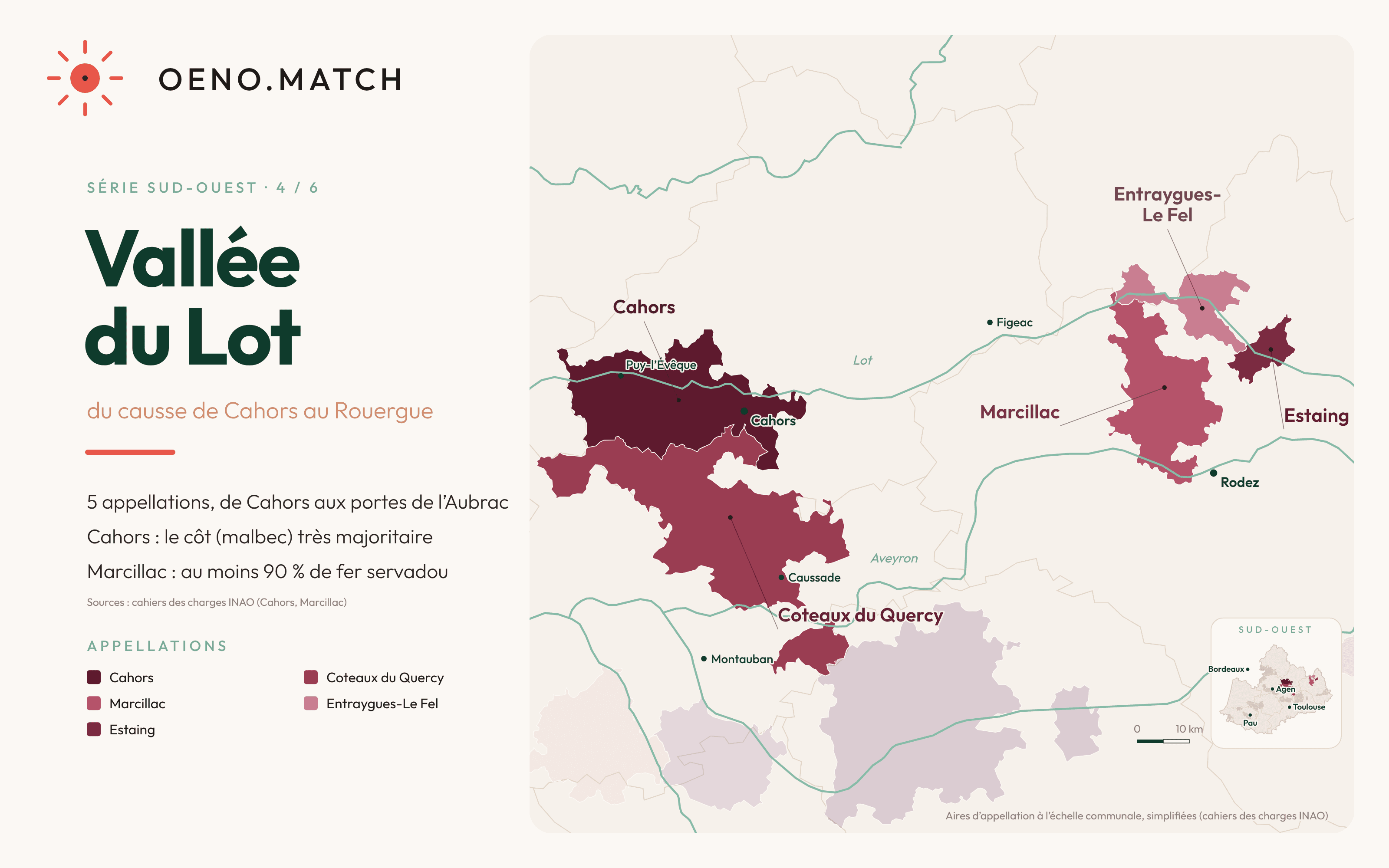
Following the Lot upstream, one crosses five appellations. The landscape transitions from the limestone of the causses to the slopes of Rouergue, where vines compete for every meter of hillside.
Cahors, the long memory of côt
The "black wine" of Cahors circulated throughout Europe from the Middle Ages onward. It traveled via Bordeaux and became known for its deep color. It owes this to côt, which is predominant in the blend according to the regulations. The Argentines adopted it under the name malbec and planted it at the foot of the Andes.
The INAO describes three terroirs in Cahors: the alluvial terraces of the Lot valley, the limestone causses at higher elevation, and Quercy blanc to the south. The côts do not have the same character in each. They are more supple on the terraces, more structured on the causses. On a single bottle, the label does not always indicate where the grapes come from; it is often the winemaker who specifies this, at the domaine or within their range.
Fabien Jouves is part of the current generation. At Mas del Périé, he works his plots in organic farming and vinifies the domaine's terroirs separately. His cuvées bear the names of the soils from which they come. He thus invites tasting Cahors by plot rather than by brand.
Coteaux du Quercy, south of the river
South of Cahors, Coteaux du Quercy occupies the limestone hills descending toward Montauban. It is a recent appellation, first recognized as VDQS before achieving AOC status. Cabernet franc holds a central place here, alongside côt, merlot, and tannat. The appellation produces mainly reds and rosés, often in a lighter style than neighboring Cahors.
Marcillac, the rougiers and mansois
Further east, in Aveyron, the Marcillac vineyard occupies the Marcillac valley, northwest of Rodez. The soils here are red: these are the "rougiers," sandstones rich in iron oxide that give the earth its brick-red hue. The landscape is recognizable from afar. Vines cling to the slopes of the valley, around the town of Marcillac-Vallon.
The grape variety is fer servadou, called mansois here. It must represent at least 90% of the plantings according to the regulations. It produces deeply colored reds with raspberry notes and a lively acidity that distinguishes them from the côt of Cahors.
Philippe Teulier runs Domaine du Cros. He has worked mansois on these rougiers for many years, in cuvées that separate plots and vine ages. His domaine often serves as an entry point for those discovering the appellation.
Entraygues-Le Fel and Estaing, at the limits of viticulture
Even higher, two tiny appellations cling to slopes that few winemakers would dare plant. Entraygues-Le Fel sits at the confluence of the Lot and Truyère rivers. Estaing rises further upstream on the Lot. These are among France's smallest AOCs.
At Estaing, the cave of Vignerons d'Olt, based in Coubisou, vinifies a significant portion of production. On these schist and granite hillsides, fer servadou sits alongside chenin and mauzac depending on the plots. This blend recalls mountain viticulture, born of practical choices. One finds dry whites and light reds, made for the local table rather than for aging.
Nicolas Carmarans settled in Campouriez, in this same sector of Aveyron. He works comparable steep plots, but outside the two appellations: his wines are sold as Vin de France and fall under no local regulations.
What the river teaches
The Lot reads like a line between two viticultures. Below, on the terraces and causses, côt ripens in the heat reflected by limestone. Moving upstream, the soils change, the air cools, the slopes steepen. The grape varieties follow or disappear. Côt gives way to mansois, then to chenin. This valley shows that geography does not merely guide wine: it ultimately decides what can grow. To sense this, one need only open side by side a Cahors from the causses and a Marcillac: the same river, two wines that bear no resemblance to each other.