
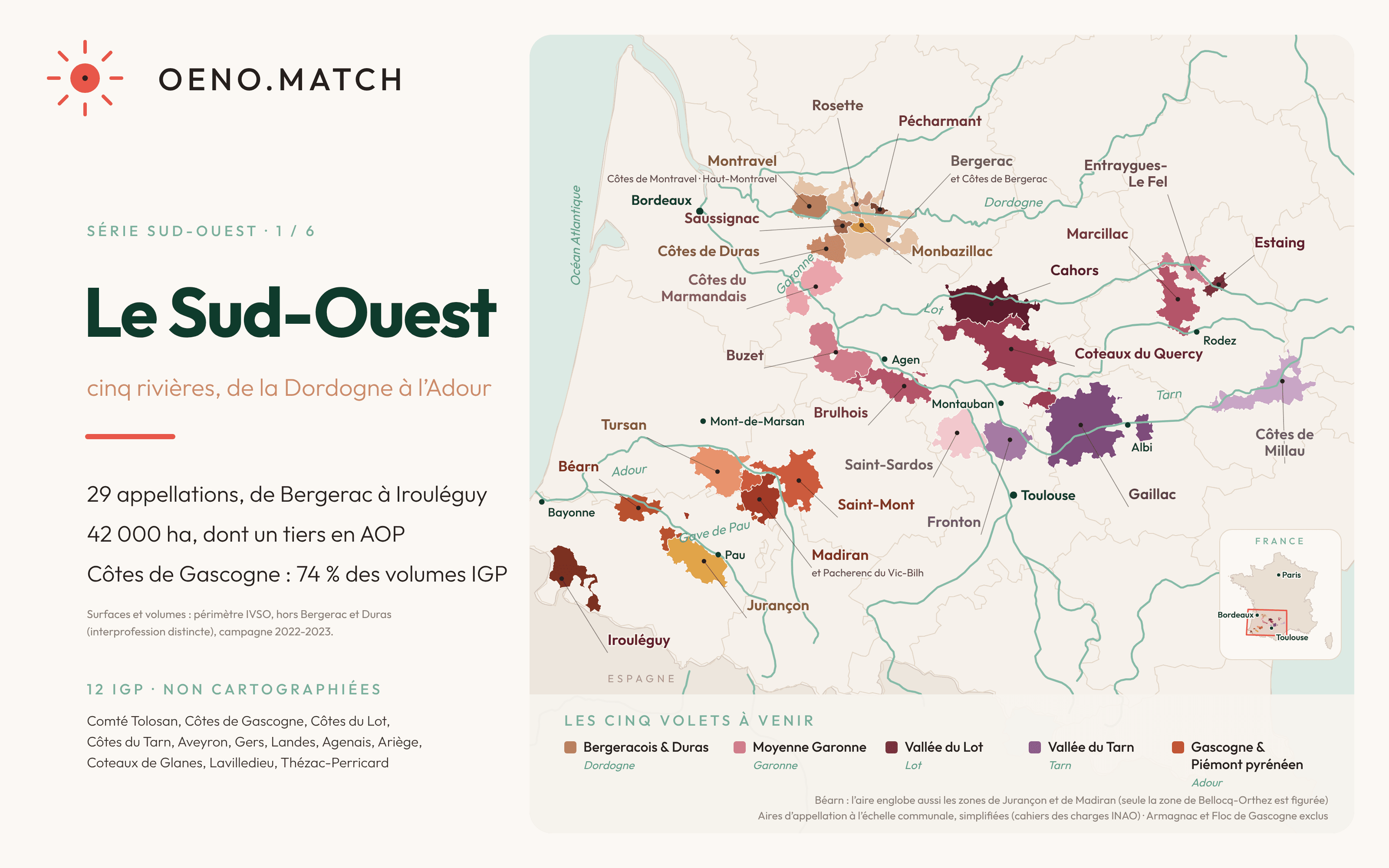
From Périgord to the foothills of the Pyrenees, South-West wine country follows five rivers that carry their wines toward the Atlantic. Long held downstream by Bordeaux, it has preserved grape varieties and characteristics found almost nowhere else.

A vineyard listed as a historic monument
In 2012, a plot of Sarragachies, in the Gers, is listed as a Historic Monument. It is the first vineyard protected in this way in France. Its vines escaped phylloxera and have never been uprooted. They mix over a few rows varieties that nurseries no longer offered. Plaimont Producteurs, the cooperative of the sector, studies these plants and multiplies them to bring them back into cultivation.
This conservation is not by chance. It stems in part from an old commercial constraint. Wines produced upstream of Bordeaux, in what was called the "Haut-Pays", faced the privilege of Bordeaux wines: they could not travel downstream and be sold on the market until the Bordeaux harvest was sold. This privilege was abolished by an edict of April 1776, prepared by Turgot, which allowed wines to circulate freely. Kept away from major markets, the vignerons of the Haut-Pays had little reason to uproot their local varieties to plant more sought-after grape varieties. This commercial setback became, over time, a heritage.
Five rivers, five characters
The Dordogne crosses purple Périgord. Around Bergerac, merlot and cabernet reds are made, as well as sweet whites; at Pécharmant, reds grow on sands and gravels. The Garonne stretches from Marmande to the gates of Toulouse, with Buzet and Côtes du Marmandais, where abouriou holds its place. The Lot carries Cahors, land of côt, called malbec in the rest of the world, planted on the terraces of the valley and on limestone plateaus. The Tarn crosses Gaillac, one of the oldest vineyards in the region. The Adour, finally, runs along the Pyrenean foothills, from Madiran to Jurançon, on hillsides exposed to southern winds.
Grape varieties as identity
Each appellation bears the name of its grape variety. Tannat gives Madiran its structure. Fer servadou, called mansois, makes Marcillac. Négrette is the basis of Fronton reds. At Gaillac, mauzac and len de l'el carry the whites, duras and prunelard the reds. Abouriou belongs to Côtes du Marmandais. Petit and gros manseng make the dry and off-dry whites of Jurançon. Côt remains the grape variety of Cahors. At Gaillac, Robert Plageoles spent years researching and replanting ondenc, len de l'el and the different forms of mauzac, which almost no one was vinifying anymore.
A vineyard predominantly IGP
The perimeter of the IVSO interprofession (excluding Bergerac and Duras) counts approximately 42,000 hectares of vineyard, of which only a third in AOP. Yet, when one thinks of South-West, one thinks first of Cahors, Madiran or Jurançon, wines for aging. The gap is explained by the weight of IGP Côtes de Gascogne: it alone represents approximately 74% of IGP volumes released from cellars during the 2022-2023 campaign. These are mainly dry whites drawn from colombard, ugni blanc, gros manseng and sauvignon, drunk young and widely exported. Gers thus produces the volume, while AOPs bet on aging and local grape varieties. The whole counts 29 appellations of origin for still and sparkling wines, and 12 IGPs. Armagnac and Floc de Gascogne, born on the same Gascon soil, fall under other sectors and are outside the scope of this series.
Two men, two levers
In 1980, Alain Brumont buys Château Montus, at Madiran. He chooses to age tannat for a long time in new barrels, contrary to the young wines sold at the time. He replants and builds a new cellar. A year earlier, in 1979, André Dubosc had participated in the creation of Plaimont Producteurs. The cooperative brings together vignerons from Gers, Hautes-Pyrénées and Pyrénées-Atlantiques. It is the one that watches over the Sarragachies vineyard today and the grape varieties it shelters. The first bet on a domain, the second on the collective; both wagered on the grape varieties of the country.
The five parts of the series will each start from a river and a story. Bergeracois and Duras will open with Patricia Atkinson, an Englishwoman settled in 1990 near Saussignac. Middle Garonne will begin at Cocumont, with Elian Da Ros and his abouriou. Lot Valley will start from the February 1956 frost and the families who replanted Cahors. Tarn Valley will follow Robert then Bernard Plageoles in their vines at Cahuzac-sur-Vère. Gascony and the Pyrenean foothills will return to Montus, where Alain Brumont changed the way tannat is aged.
Sources: Key figures IVSO, South-West basin council, DRAAF Occitanie, Nov. 2023 (https://draaf.occitanie.agriculture.gouv.fr/IMG/pdf/1-1-ivso_marches_cbso_20231108.pdf); Edict of the King given at Versailles in April 1776 allowing wines to circulate freely, BnF (https://catalogue.bnf.fr/ark:/12148/cb338460562); Sarragachies Vineyard (https://fr.wikipedia.org/wiki/Vigne_de_Sarragachies); A. Dubosc, Encounters of Modest Grape Varieties 2013 (https://www.rencontres-des-cepages-modestes.com/rencontres/2013/2013_doc/11_Dubosc.pdf); Pécharmant Vineyard (https://fr.wikipedia.org/wiki/Vignoble_de_P%C3%A9charmant); Dordogne Périgord Tourism; Cahier des charges Côtes du Marmandais (INAO).