
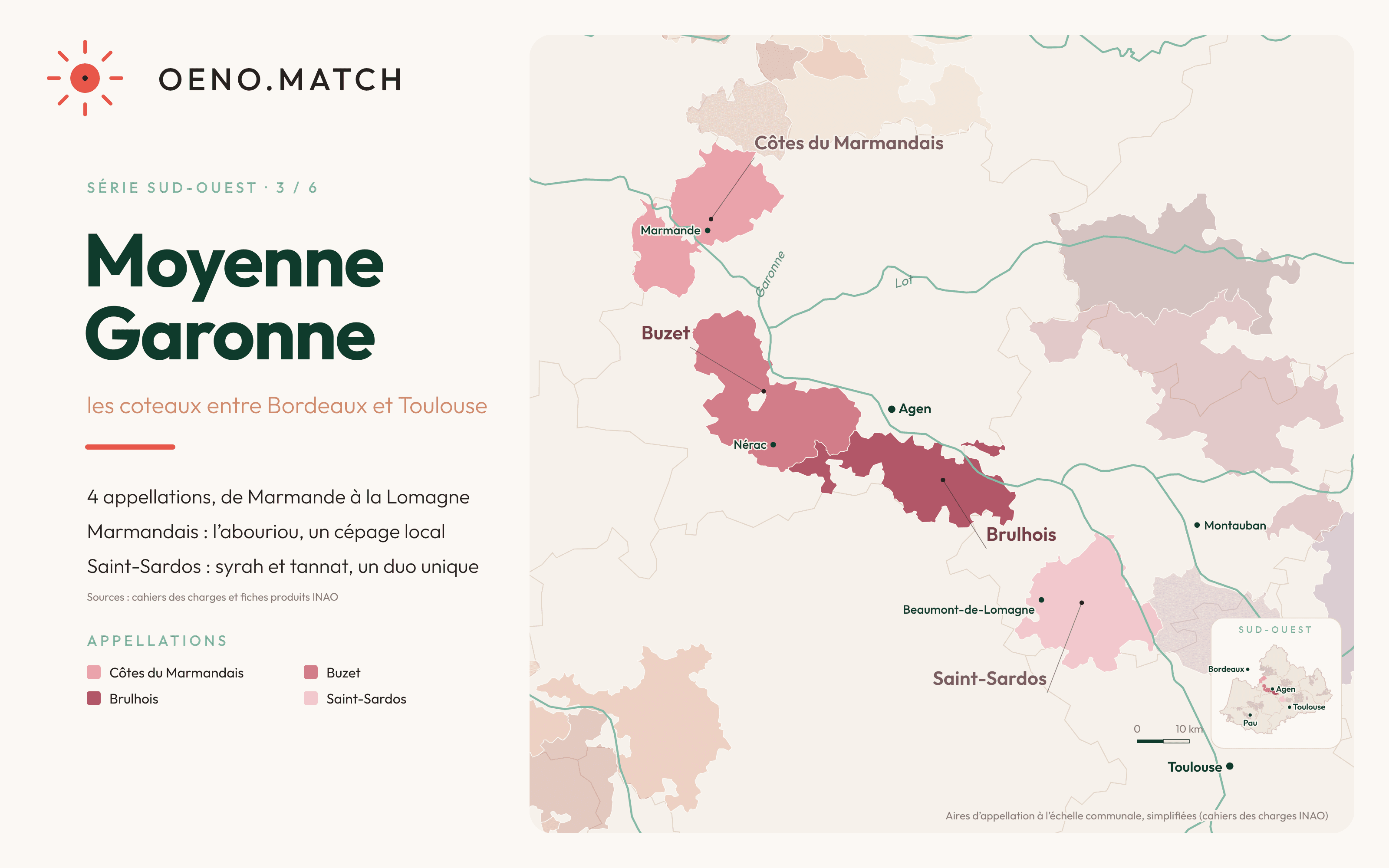
Between Marmande and Toulouse, the Garonne flows past vineyards that are often overlooked. These are lands of cooperatives and discreet winemakers, where Bordeaux grape varieties sit alongside local varieties.

Elian Da Ros grew up in Cocumont, in the Côtes du Marmandais, within a family of winemakers. From 1992 to 1997, he worked in Alsace, at Zind-Humbrecht. He returned in 1997, left the cooperative and signed his first vintage in 1998. He then made abouriou, a grape variety that many of his neighbours considered secondary, the heart of a cuvée that bears his name.
He vinifies it in whole bunches. Terre de vins describes this wine as supple and fruity, with airs of gamay. He seeks neither colour nor power. He preserves the fruit, freshness and fine skin of the grape. This approach demonstrates what Marmandais can do with its own grape variety, when one stops treating it as a supplement.
Marmandais, cooperation and singularity
The appellation extends around Marmande, on both banks of the Garonne, bordering Gironde vineyards. Cooperation weighs heavily there: it allowed small operators to remain in place, when they would not have been able to finance a cellar alone.
The regulations list abouriou among the complementary grape varieties, alongside côt, fer, gamay and syrah. Nothing requires it, and a winemaker can do without it. But the same text emphasizes that it makes the originality of Marmandais reds. It is through this variety that the appellation distinguishes itself from its Gironde neighbours.
Buzet, the hillsides of Albret
Further south, Buzet vineyards cover the hillsides of the Albret region, around Nérac, between the Garonne and the Landes de Gascogne. The appellation is organized around a single structure: the cave des Vignerons de Buzet, which vinifies the bulk of production.
This model has its limits, as a single dominant cellar leaves less room for stylistic variation. It has also enabled investment in cellars and ageing. Buzet reds rest on merlot and cabernets. They favour consistency over rupture. For the enthusiast seeking a Bordeaux-style red at a fair price, it is an honest answer. For those wanting the unexpected, the rest of the series offers other leads.
Brulhois, the memory of black wine
South of Agen, on either side of the Garonne, Brulhois claims an ancient reputation. In the Middle Ages, its dark wines descended the Garonne under the name of "black wines". Today's blends revolve around tannat, cabernets and merlot; côt and fer are also permitted.
The appellation obtained AOC status in 2011. Its production passes for the most part through Les Vignerons du Brulhois, born in 2001 from the merger of the Donzac and Layrac cellars. Tannat remains the element that marks the wine and gives it its structure. The name "black wine" is not metaphorical: it designated very coloured wines.
Saint-Sardos, the abbey and syrah
Further east, in Lomagne, between Garonne and Save, the Garonne terraces bear Saint-Sardos. The appellation was recognized as AOVDQS in 2005, then as AOC in 2011. Its surface remains modest.
The story begins long before the texts. In the twelfth century, Cistercian monks from the abbey of Grandselve planted vineyards on these lands. The current vineyard claims this lineage.
The regulations establish what distinguishes Saint-Sardos: it is the only vineyard in France that mandatorily associates syrah and tannat in the blend. Syrah brings black fruit and pepper, tannat structure. This marriage gives a profile unique to this appellation.
What these four vineyards have in common
None of these appellations seeks great rankings. All grew in the shadow of Bordeaux. Each has found its own element: a grape variety in Marmande, a collective cellar in Buzet, a memory in Brulhois, a blend in Saint-Sardos.
They must be drunk for themselves, without comparing them to what they might have been if the map had been drawn differently. This is the only way to grasp their logic. An abouriou from Cocumont is drunk fresh, with poultry or charcuterie. A Buzet accompanies everyday cuisine. A Brulhois calls for a richer dish, a confit or a magret. A Saint-Sardos is tasted with grilled meat, when the syrah speaks first and the tannat follows. The Garonne connects these vineyards far more than it ties them to Bordeaux.