
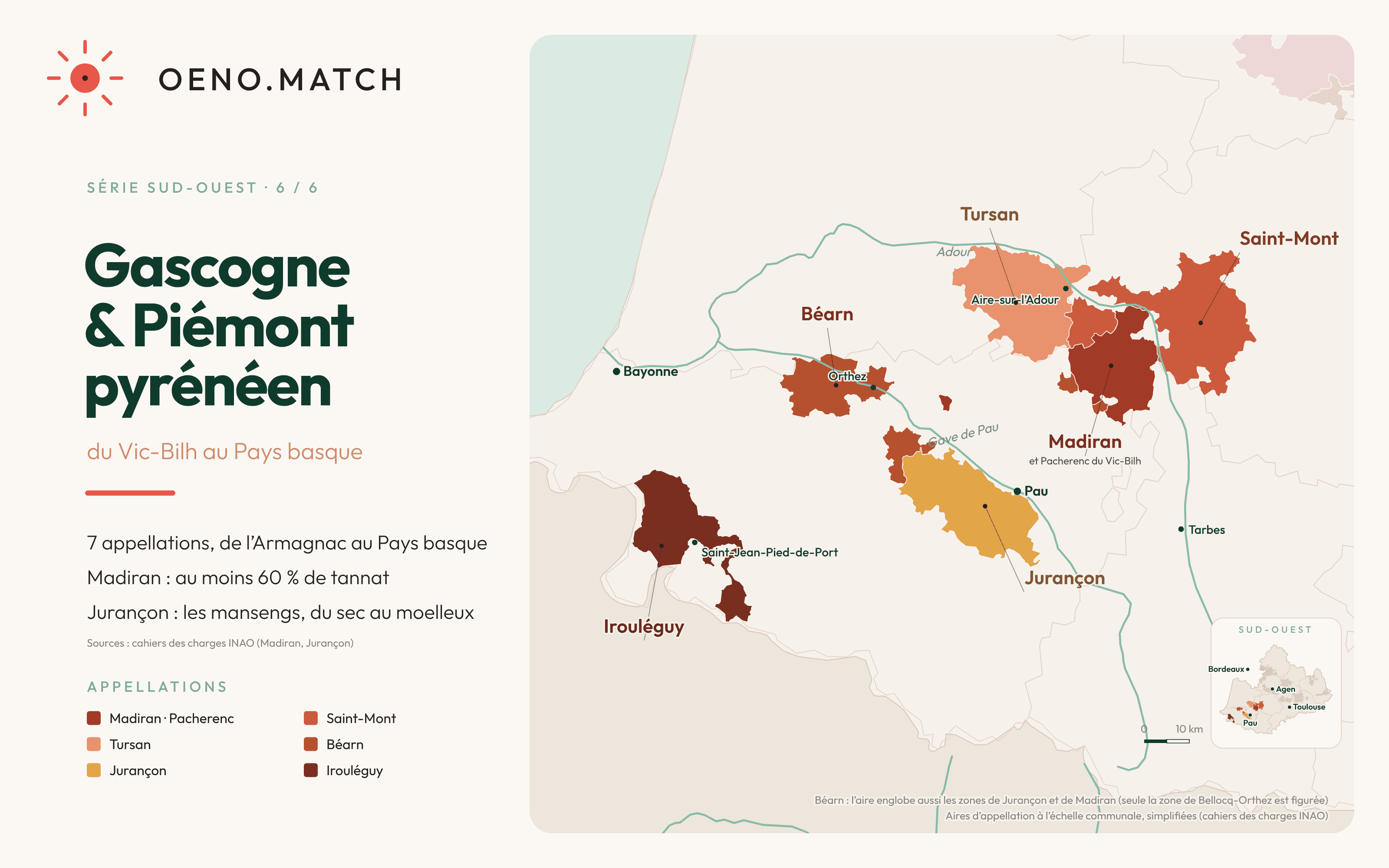
From Vic-Bilh to the Basque Country, seven appellations share the same foundation of grape varieties: tannat for reds, petit and gros manseng for whites. This final installment of the series follows them from the Adour plain to the Basque terraces.

When Alain Brumont purchases Château Montus in 1980, Madiran is drunk mainly locally and passes for a rustic wine. Brumont bets on the appellation's grape variety, tannat. He has his wines aged in new barrels, at a scale that local practices had not yet known. He also works on the selection of his parcels and grape maturity. The name Montus then begins to circulate well beyond Vic-Bilh.
Madiran and Pacherenc: one area, two colours
The Madiran area extends across Hautes-Pyrénées, Gers, and Pyrénées-Atlantiques. In 2024, it counted 964 hectares planted, according to data published on the appellation. The regulations require at least 60% tannat in the blend, supplemented by cabernet franc, cabernet sauvignon, or fer servadou. This thick-skinned tannat gives Madiran its structure and ageing potential.
In 2006, researcher Roger Corder published work in the journal Nature on procyanidins in certain red wines, including tannat wines. This work concerns wine chemistry; it supports no health claims.
On the same area, Pacherenc du Vic-Bilh produces whites from petit and gros manseng, with arrufiac. It exists in dry form as well as sweet, the latter from late harvests.
Saint-Mont and Tursan: Plaimont and Bachen
Saint-Mont extends into Gers, north of Madiran. The appellation owes much to Plaimont Producteurs, which vinifies most of it. It was Plaimont that had the Sarragachies vine studied, whose stocks escaped phylloxera. It was listed as a Historic Monument in 2012, a first for a vineyard in France.
Further west, Tursan is located in Landes. The appellation is linked to Michel Guérard, the chef of Eugénie-les-Bains, who took over Château de Bachen to make it a wine property. Tursan whites often call upon baroque, a local grape variety that marks the appellation.
Jurançon and Béarn: mansengs and royal memory
Jurançon extends over the hillsides south of Pau. Petit and gros manseng form the basis of the planting there. For sweet wines, grapes are left on the vine until late autumn: they shrivel and concentrate their sugars. From this come sweet Jurançon and late harvests. Dry Jurançon, picked earlier, has a tighter profile, often marked by citrus.
Tradition holds that King Henri IV, born in Pau in 1553, had his lips rubbed with garlic and moistened with Jurançon wine at his birth. No contemporary source confirms this: it is a transmitted account, not an established fact.
Henri Ramonteu runs Domaine Cauhapé, in Monein. He produces dry and sweet Jurançon there, and has worked to make the dry a wine in its own right, with its own cuvées.
The Béarn appellation requires clarification. Its area covers its birthplace around Bellocq and Orthez, but also encompasses the zones of Jurançon and Madiran. Its reds rest mainly on tannat, often with cabernet franc.
Irouléguy, the Basque terraces
Irouléguy is the westernmost and most mountainous appellation of the group. Its vines are tiered in terraces around Saint-Étienne-de-Baïgorry, in Pyrénées-Atlantiques. Tannat dominates the reds and rosés; whites rest on mansengs.
The Irouléguy cooperative cellar, founded in the mid-twentieth century, long carried most of the production. Independent estates later appeared. Thérèse and Michel Riouspeyrous, at Domaine Arretxea, work their parcels in biodynamics, on slopes where each row is earned.
What holds these seven appellations together is less a style than a foundation: tannat, mansengs, and an attachment to local grape varieties. On the same territory, Armagnac and Floc de Gascogne belong to another tradition and another subject. The series ends here, after twenty-nine appellations traversed from Bergerac to the foothills of the Pyrenees. It began in a vineyard listed as a monument; it ends in a cellar where a man chose to take tannat seriously.