
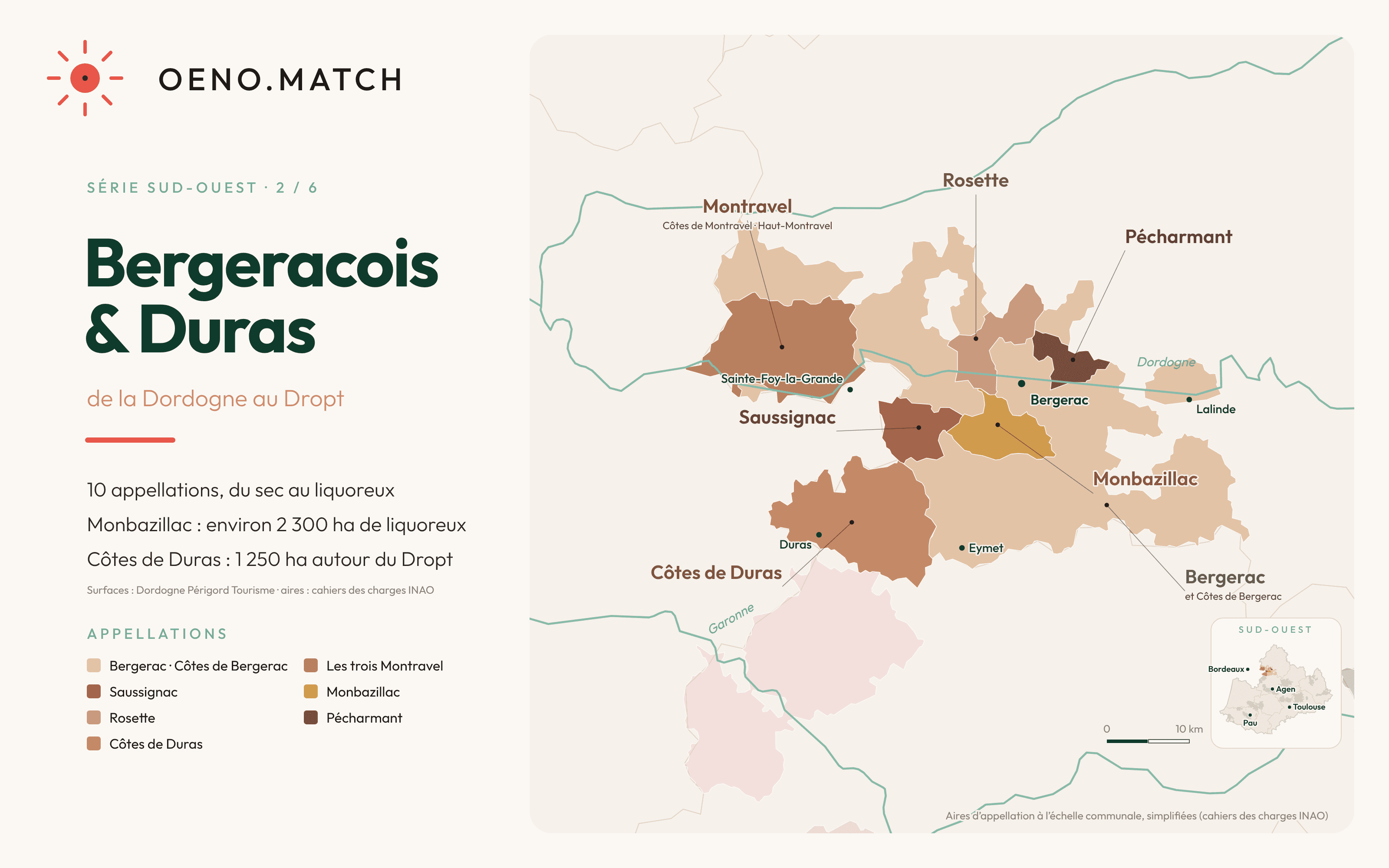
Between Libournais and Lot-et-Garonne, Bergeracois and Côtes de Duras follow the Dordogne then the Dropt. This vineyard built its distinctiveness on sweet and dessert whites, without abandoning age-worthy reds.

Its wines long traveled downriver toward Bordeaux, then toward ports in northern Europe. In the 17th and 18th centuries, Dutch merchants were among the major buyers of the region's white wines, according to Dordogne Périgord Tourisme.
An Englishwoman in Bergeracois
In 1990, Patricia Atkinson settled in Gageac-et-Rouillac, near Saussignac, at the estate that would become Clos d'Yvigne. She learned the trade on her own vines, often alone. She recounts this experience in a book published in 2003, The Ripening Sun. Her journey leads directly to the sweet wines of the left bank, with Saussignac at the forefront.
The Saussignac appellation, southwest of Bergerac, is reserved for dessert whites made from sémillon, sauvignon, and muscadelle. Wine here is born from noble rot, botrytis cinerea. This fungus concentrates the sugars in the grape when autumn alternates between morning mists and sunny afternoons.
Dessert wine as signature
Monbazillac is the other major name in Bergeracois sweet wines. The appellation covers approximately 2,300 hectares on the left bank of the Dordogne, facing the town of Bergerac. It too produces only dessert wines born from botrytis.
The difference between sweet and dessert wine lies in concentration. A sweet wine retains perceptible sugars, without going further. A dessert wine comes from successive selections: grapes are picked bunch by bunch, sometimes berry by berry, those touched by noble rot. It reaches much higher sugar levels and can age for a long time. Monbazillac and Saussignac produce dessert wines; Côtes de Montravel and Haut-Montravel aim for the sweet wine category.
At Monbazillac, Claudie and Bruno Bilancini arrived at Château Tirecul la Gravière in 1992. They leased the estate, then purchased it in 1997. They produce dessert wines intended for aging. Harvesting is done through successive passes through the rows, by hand, at the pace of noble rot.
On the right bank, from Pécharmant to Montravel
On the right bank of the Dordogne, east of Bergerac, Pécharmant produces age-worthy reds. Vines grow on ferruginous sands and gravels. The grape varieties are those of neighboring Bordeaux: merlot, cabernet franc, cabernet sauvignon, malbec.
Rosette, on the same bank, north of Bergerac, produces only light sweet whites, in very small quantities. It is the most discreet appellation in Bergeracois.
The two base appellations cover the entire perimeter. Bergerac produces reds, rosés, and dry whites. Côtes de Bergerac comes in red, with slightly stricter rules, and sweet white.
Further west, at the borders of Gironde, the Montravel area runs along the right bank. The château of Michel de Montaigne is located there, in Saint-Michel-de-Montaigne. The essayist wrote a large part of his Essays there. Three appellations share the styles without overlapping: Montravel for dry whites and, more recently, for reds; Côtes de Montravel and Haut-Montravel for sweet whites, with different sugar richness requirements.
Duras, to the south on the Dropt
Côtes de Duras form a distinct vineyard, south of Bergeracois, on the Dropt plateau, in Lot-et-Garonne. The appellation covers approximately 1,250 hectares. Reds, dry whites, and sweet wines are produced there, with the same grape varieties as the neighbors. Catherine and Jean-Mary Le Bihan run Domaine Mouthes Le Bihan. They work with all three colors of the appellation. The Dropt, a small river that joins the Garonne, gives the sector a landscape of plateaus and valleys distinct from that of the Dordogne.
Three bottles to understand the region
A dry white from Montravel or Bergerac, made from sauvignon and sémillon, to start with freshness. A Monbazillac aged five to ten years, to measure what botrytis gives when given time. An age-worthy Pécharmant, to feel what the ferruginous soils of the right bank bring to merlot and cabernets. Taste them in this order, from driest to richest, saving the red for the table. Dessert wine finds its place with blue cheese or at the end of a meal, in small quantity. Three glasses are enough to place a vineyard more diverse than one might think.