
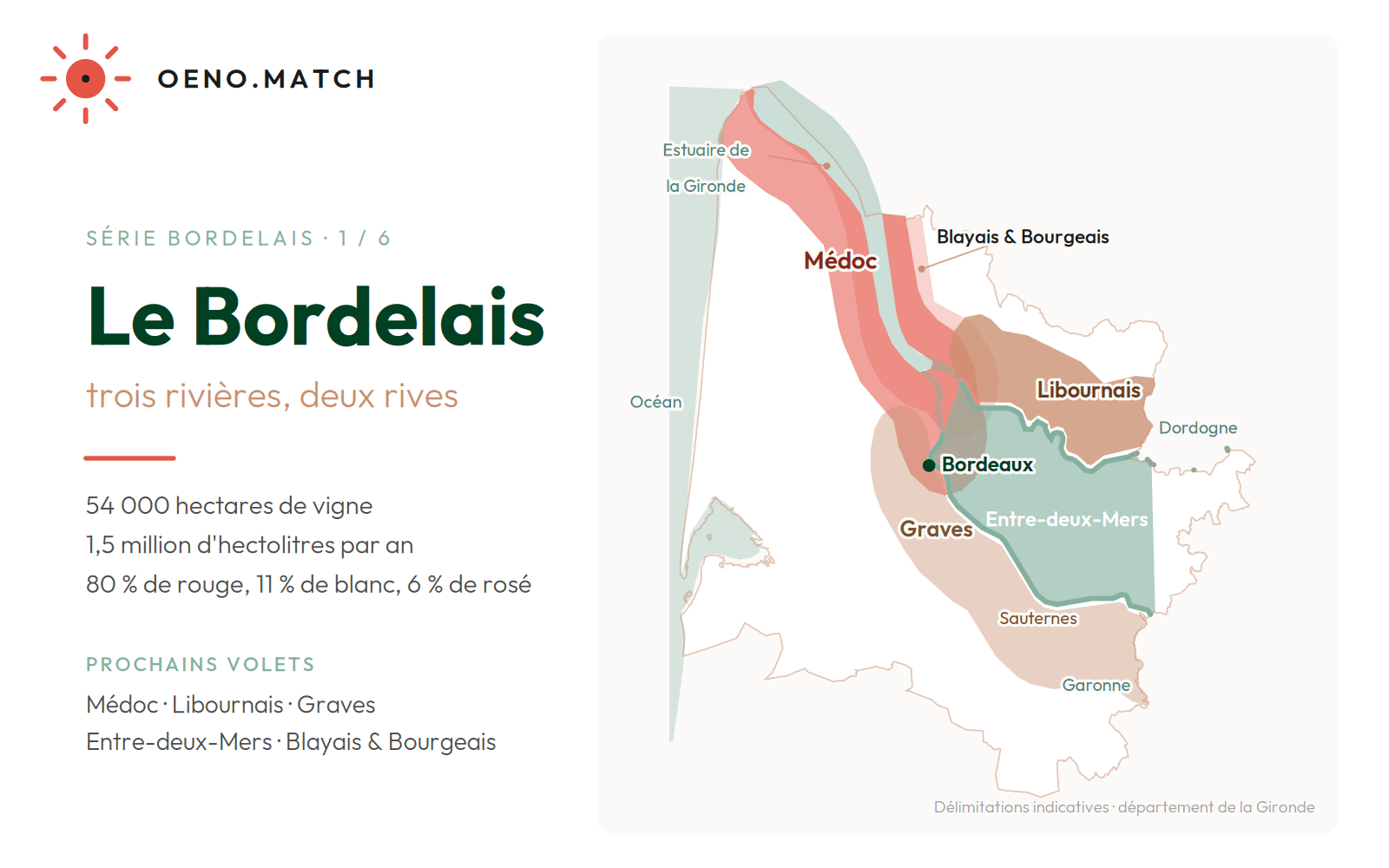
Bordeaux is probably the most famous wine region in the world. Yet this reputation masks a reality: few consumers understand the diversity of its terroirs and the complex layers of classifications that compose it. Nevertheless, the region produces wines of great aromatic complexity that deserve closer examination.
Oeno.match has therefore decided to offer you a series of six articles to deepen your knowledge of this magnificent region and help you in your future tastings of its delicious wines.
We begin this series with an overview of the 54,000 hectares of vineyard and approximately 1.5 million hectoliters produced annually, before delving into each of the 5 regions of Bordeaux.
Three rivers and two banks
The Garonne rises from the south, the Dordogne arrives from the east, and they meet at Bec d'Ambès to form the Gironde estuary. The entire vineyard clings to these three axes.
Left bank: Graves and Médoc, to which are added the sweet wines of Sauternes and Barsac. Right bank: Libournais, with Saint-Émilion and Pomerol, then Bourgeais and Blayais heading north. Between the two arms, Entre-deux-Mers.
The specificity of soils
The rivers above all deposited soil specificities whose impact on wines is crucial. Through quaternary glaciations, the Garonne carried from the Pyrenees and the Massif Central layers of pebbles that it abandoned in terraces along its left bank. These are the gravel ridges of Médoc and Graves, domes of rolled stones sometimes several meters deep.
Gravel soil retains neither water nor fertility. The vine descends to find nourishment ten meters deep, suffers, and produces small berries with thick skins. The pebbles store the day's heat and release it at night; the estuary moderates frosts: Cabernet Sauvignon, a late-ripening variety that reaches maturity only in mid-October, gains the few degree-days it lacks elsewhere. This creates wines built on structure, austere when young, made for aging.
The right bank tells the opposite story. The Saint-Émilion plateau rests on limestone with oyster shells capped by clays; Pomerol sits on blue clays speckled with iron oxides, iron scrap. Clay is cold, warms slowly in spring, and retains water. Cabernet Sauvignon ripens poorly there, almost always late. Merlot, which buds and ripens two to three weeks earlier, adapts well, and the soil's water reserves protect it from dry summers. This produces wines that are fleshier, rounder, approachable when younger.
Forty kilometers separate Pauillac from Pomerol. The dominant variety, texture, and aging rhythm change completely. The soil decided before man did.
A culture of blending
While monovarietal wines characterize the other major region of French vineyards, Burgundy, Bordeaux almost never makes monovarietal wines. In red, Merlot and Cabernet Sauvignon lead, supported by Cabernet Franc, Malbec, and Petit Verdot. Carménère disappeared from the region after phylloxera and has rebuilt its career in Chile. In white, Sémillon and Sauvignon, with a little Muscadelle.
Red accounts for 80% of production. The rest is divided between dry and sweet whites (11%), rosés (6%), crémants (2%), and clairets (1%). This last figure deserves attention: clairet, a light red with little extraction, descends directly from the claret that the English drank in the Middle Ages.
The pyramid of classifications
Bordeaux has created a labyrinth of appellations and classifications that is almost incomprehensible to the novice and whose usefulness is still questioned today.
First, multiple appellations overlap:
Regional AOCs: Bordeaux, Bordeaux Supérieur, Crémant de Bordeaux. They cover all of Gironde's vineyards and form the first volume of the department.
Sub-regional AOCs: Médoc, Haut-Médoc, Graves, Entre-deux-Mers.
Communal AOCs: Pauillac, Margaux, Saint-Émilion, Pomerol.
To this pyramid are added not one, but five distinct classifications:
1855: Médoc and Sauternes-Barsac. Only one revision since its publication, in 1973, to elevate Mouton-Rothschild to the rank of first growth.
Graves, 1959: Sixteen non-revisable crus, all in Pessac-Léognan.
Saint-Émilion: Revisable every ten years under INAO authority, leading to multiple disputes that would deserve a separate article entirely.
Crus Bourgeois of Médoc: Selection republished annually since 2010.
Crus Artisans: Every ten years, reserved for properties under five hectares.
Another Bordeaux singularity: châteaux are classified, not parcels. A cru that purchases its neighbor's vines thus extends its classification. In Burgundy, where only the terroir is classified, such a move is impossible.
Being part of a classification is a coveted key that creates two categories of producers operating in different spheres.
Eight centuries of commerce
The vine has been here since the first century AD, but commercial history opens in 1152: the marriage of Eleanor of Aquitaine and Henry Plantagenet delivers the English market to claret. The Dutch take over in the 17th century and impose sweet whites and barrel aging. In the 18th century, the English pay more for new French clarets, and the idea that a specific terroir produces great wine takes hold. Then: 1855, phylloxera, post-war restart with 1961, 1982, 1989, 1990.
Coming in the weeks ahead: five articles, one per sub-region: Médoc, Libournais, Graves, Entre-deux-Mers, Blayais and Bourgeais.
Each with its soils, appellations, dominant varieties, and useful reference points when a bottle arrives in your cellar.