
Listen to the article
Médoc, the left bank in red
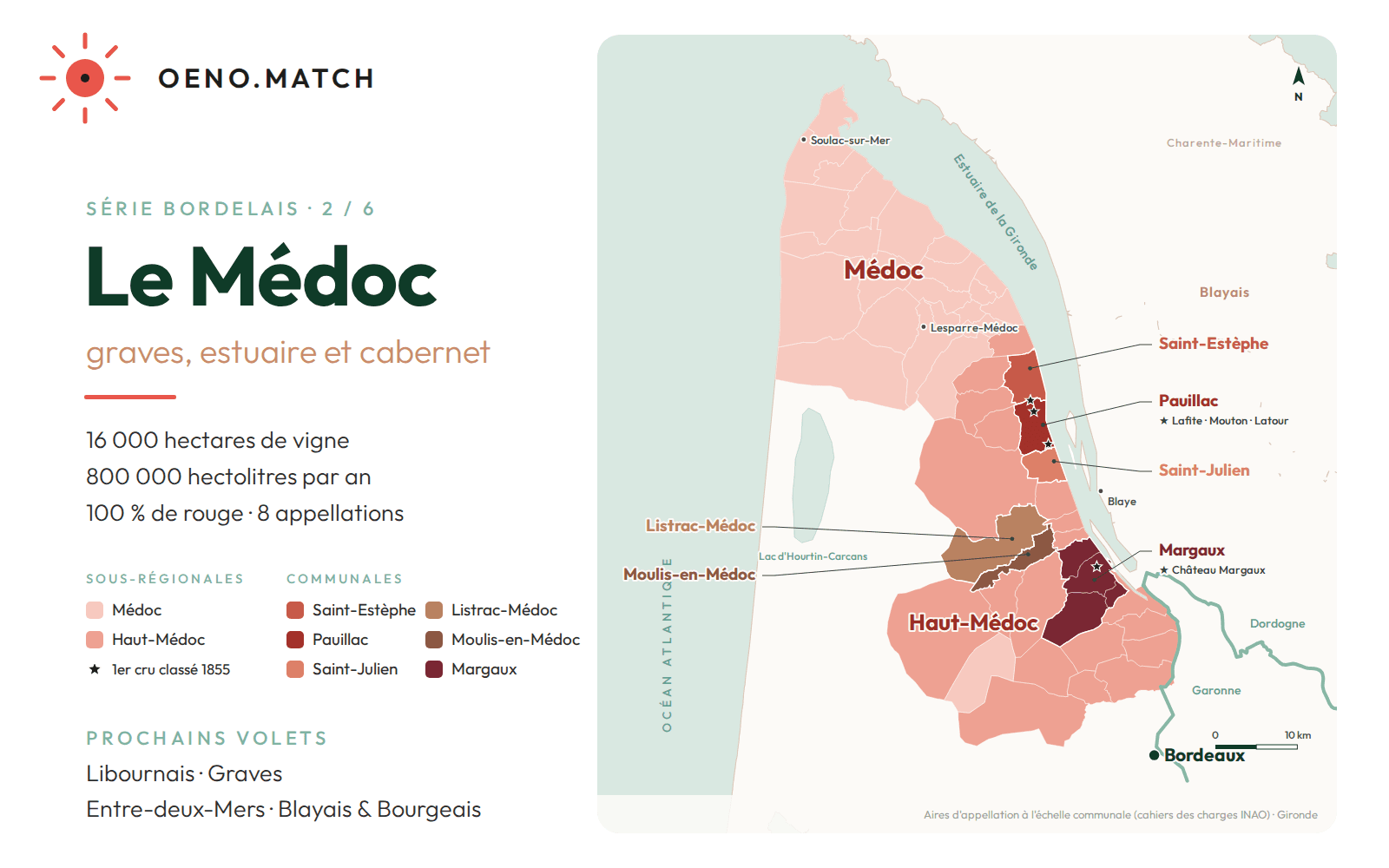
On a map, Médoc looks like a strip of land wedged between the ocean to the west and the Gironde estuary to the east. The vineyard has settled along the estuary, on a band more than 80 km long and about ten kilometers wide, from Blanquefort, at the gates of Bordeaux, to Saint-Vivien, almost at the tip.
Graves, palus and limestone
The secret of Médoc lies first in the graves. These are pebbles, sand and gravel brought by the Garonne, which form small hillocks, the "croupes". In Haut-Médoc, they barely reach forty meters in height. These soils allow water to drain and retain heat. The vine must send its roots deep, and Cabernet Sauvignon, a late-ripening variety, finds what it needs to mature here.
Between these croupes and the estuary extend the palus, lands of clay and silt deposited by the river. They host mainly meadows and woods. Small streams, the jalles and esteys, drain the croupes toward the Gironde. An amusing detail: they often serve as boundaries between two appellations.
Beneath the graves lie limestone and clay, which surface in places, notably at Saint-Estèphe, Listrac and Moulis. Merlot often takes up a bit more space there than elsewhere in Médoc.
On the right bank, at Saint-Émilion or Pomerol, clay and limestone dominate and Merlot leads the way. In Médoc, it is the graves that set the tone, and Cabernet Sauvignon with them.
A 100% red vineyard
Médoc produces only red wine. No dry white like in Graves or Entre-deux-Mers, no sweet wine like in Sauternes. Over approximately 16,000 hectares, it produces nearly 800,000 hectoliters of wine each year.
These are always blends: Cabernet Sauvignon leads the way, followed by Merlot, Cabernet Franc, Petit Verdot and, marginally, Malbec. The wines are structured and often benefit from aging in the cellar for a few years.
Eight appellations, two levels
Médoc has eight AOCs. Two are called sub-regional and together cover 60% of the Médoc vineyard. On paper, the AOC Médoc area covers the entire peninsula, down to the Atlantic coast. In practice, its vineyards concentrate in the north, from Saint-Germain-d'Esteuil to Saint-Vivien. The AOC Haut-Médoc extends to the south, from Blanquefort to Saint-Seurin-de-Cadourne. A small pitfall for beginners: "haut" does not mean "better". It designates the upstream part, closer to Bordeaux.
The other six are communal and are all located in the Haut-Médoc zone. From north to south, you encounter Saint-Estèphe, Pauillac and Saint-Julien on the edge of the estuary, then Listrac-Médoc and Moulis-en-Médoc a bit further inland, and finally Margaux. This is where the most well-known wines and most of the classified growths are concentrated.
The 1855 Classification
Médoc has its own hierarchy, established in 1855 under the Second Empire. The criterion: the selling price of wines at the time. The châteaux were divided into five categories, from first to fifth classified growth.
Almost all the selected châteaux are from Médoc. The notable exception is Château Haut-Brion, located in Graves, ranked among the first growths. The other first growths are Lafite Rothschild, Latour and Mouton Rothschild in Pauillac, as well as Château Margaux.
This classification has barely changed since. The most famous change dates to 1973, when Mouton Rothschild moved from second to first growth. (To be entirely accurate, Château Cantemerle had been added to the fifth growths as early as 1856.) The Saint-Émilion classification, meanwhile, is revised approximately every ten years.
Where to start?
The simplest approach is to open two bottles side by side: a Margaux, often described as finer and more perfumed, and a Pauillac, reputed to be more powerful. These are tendencies, not rules. For a reasonable budget, the AOC Médoc and Haut-Médoc and the crus bourgeois already give a good sense of the style.
Taste and share your impressions on Oeno.match!
Next article in the series: Libournais