
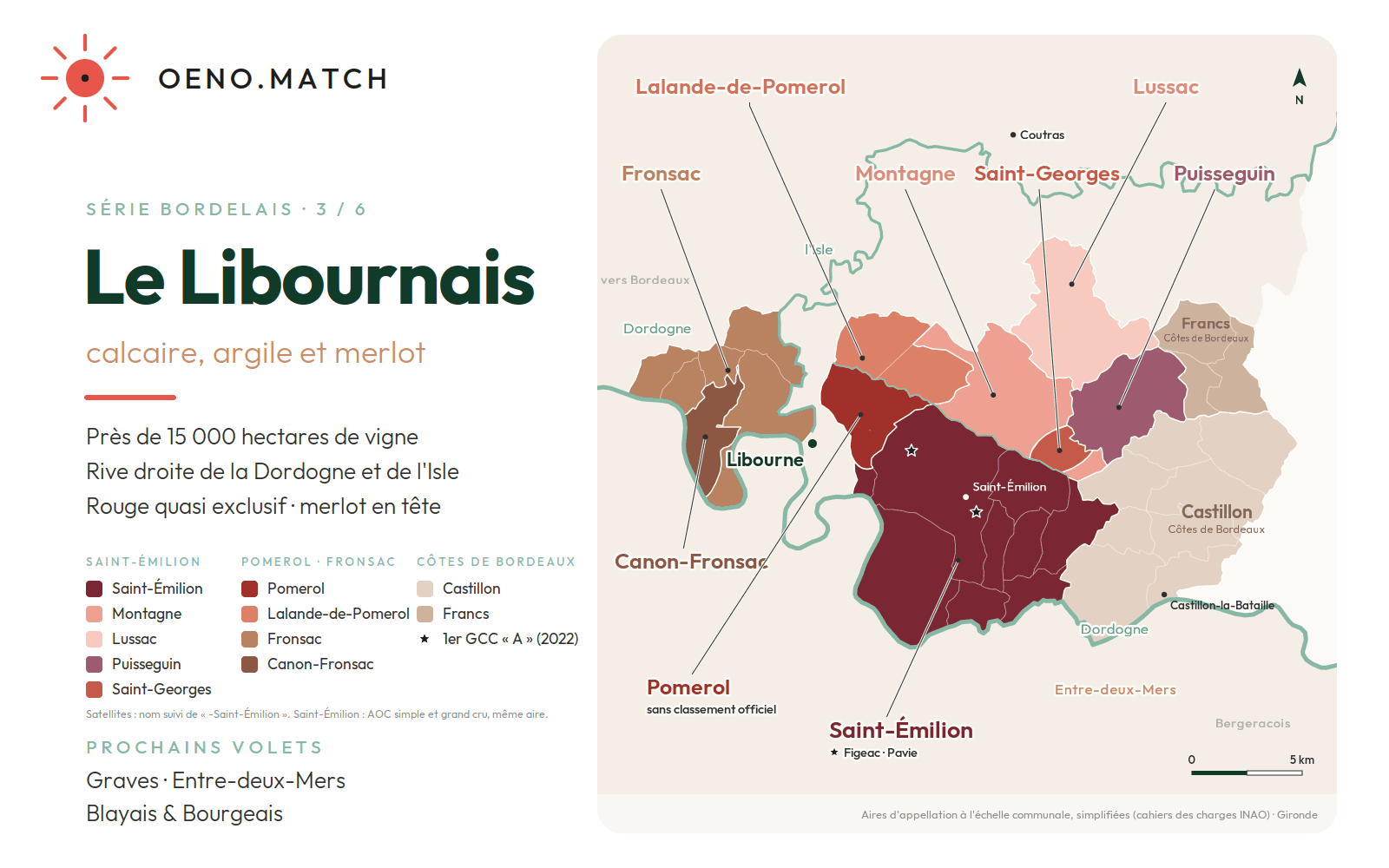
Libourne, founded in 1270 by Roger de Leyburn, English seneschal of Gascony, long served as a commercial lock on the Dordogne before becoming the heart of one of Bordeaux's densest vineyards. The town gives its name to an entire riverbank, and this riverbank has come to build a viticultural identity radically different from that of the Médoc, despite being situated just tens of kilometers away as the crow flies.
The Libournais is first and foremost a figure: 15,200 hectares of vines, for an annual production of approximately 650,000 hectoliters. Nearly all of it — 99% — is devoted to red wines. We are far from the dry whites that bring glory to the Graves or the sweet wines of Sauternes. Here, everything is organized around a single grape variety, merlot, which imposes its logic of early maturity, roundness and fruit on terroirs that suit it exceptionally well.
This terroir is the real subject. Viticultural sources agree in distinguishing several types of soils: limestone on the plateaus of Saint-Émilion, deep clays in Pomerol, sands and soft sandstones laden with iron oxide in more peripheral sectors such as Fronsac. This mosaic explains why merlot can express such different facets depending on the appellation — fleshy and velvety in Pomerol, more tense and mineral in Saint-Émilion on its parcels of asteriated limestone.
The region's international reputation rests largely on Pomerol, and in particular on Château Pétrus. The anecdote is well known but remains striking: Pomerol has never had an official classification. While Saint-Émilion equipped itself with one as early as 1955 — revised for the last time in 2012, with 4 grands crus classés A, 14 premiers grands crus classés B and 64 grands crus classés —, Pomerol has always refused to submit to any hierarchical evaluation system. Pétrus, an estate of less than 12 hectares cultivated almost exclusively in merlot, has built itself a worldwide reputation without ever appearing on any official list!
What makes Pétrus geologically unique is the presence of a button of blue clay on the surface — a vein of very dense clay that retains moisture, slows maturation and concentrates aromas. This singularity forms part of the myth.
Around these two flagship appellations gravitates an entire constellation of less publicized names but often underestimated. The satellites of Saint-Émilion — Lussac, Montagne, Puisseguin, Saint-Georges — produce wines in the same spirit, at much lower prices. Lalande-de-Pomerol, to the north, offers a direct alternative to Pomerol with wines often comparable in their youth. Fronsac and Canon-Fronsac, a little further west, remain very confidential values despite a quality argilo-limestone terroir.
What fundamentally characterizes this right bank compared to the Médoc is the structure of properties. We are here in a world of small holdings, several hundred châteaux in the Saint-Émilion appellation alone, rather than large concentrated estates. This fragmentation creates considerable diversity of styles and quality levels, which makes the region difficult to grasp but exciting to explore. The share of cabernet sauvignon is structurally lower here than in the Médoc, sometimes absent, and it is cabernet franc that plays the role of secondary blend — bringing freshness and pepper where merlot provides body.
With 15,200 hectares and production dominated 99% by reds, according to available regional data, the Libournais is a region that offers great diversity beyond its two flagship appellations. Its satellites and peripheral appellations offer serious ground for enthusiasts seeking quality without the entry price of the great names.
Next article in this series on the Bordeaux vineyard: the Graves.