
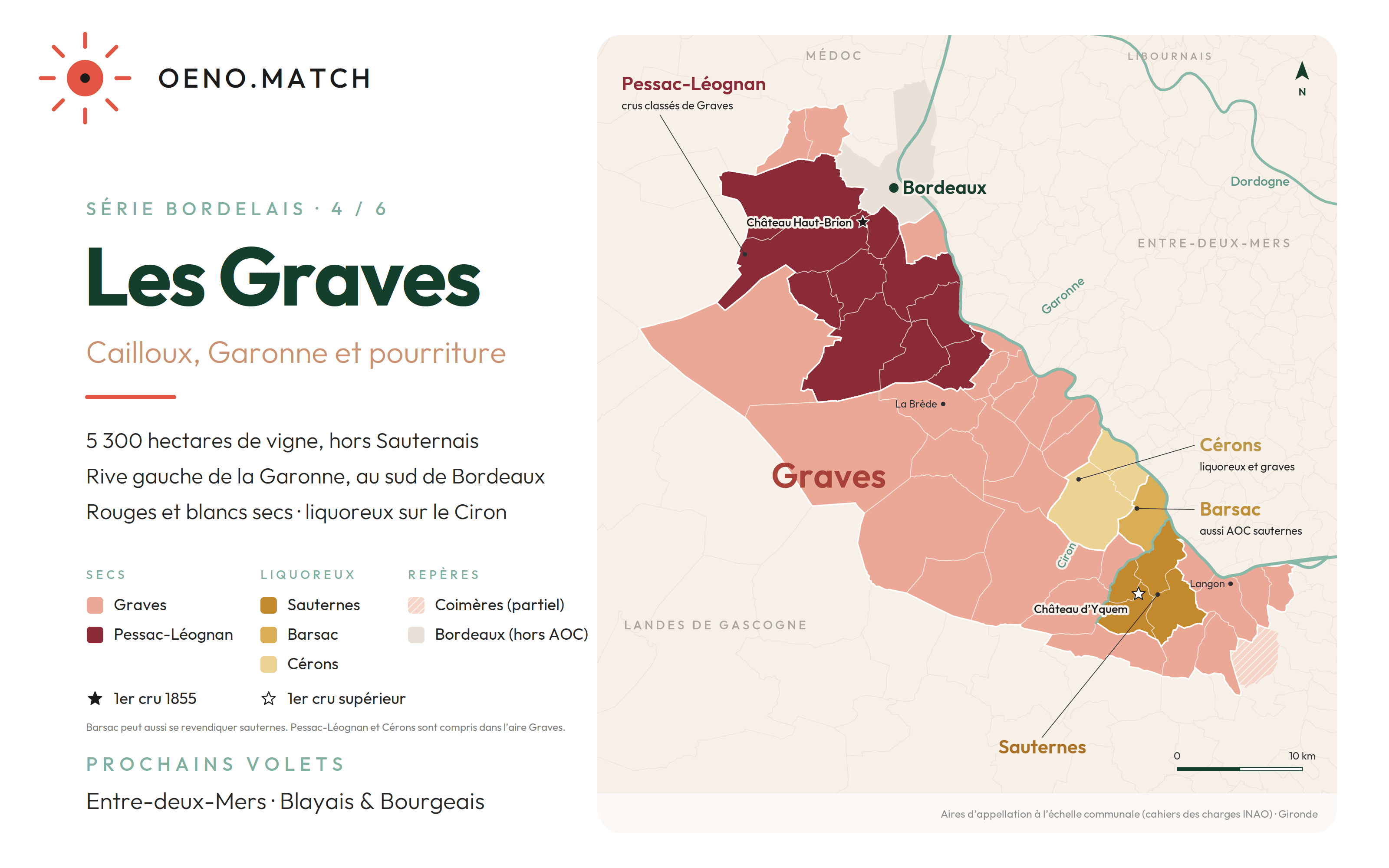
The Graves are one of the oldest vineyards in Bordeaux. Vines have been present there since Roman times, and it is in the Middle Ages that the name of the region appears, directly inspired by the rolled pebble soils that characterize it, the grabas of Burdeus. These graves, pebbles shaped by the Garonne, are determining factors in the viticultural identity of this sub-region: they drain water and accumulate heat during the day which is released at night. Planted in close proximity to Bordeaux, on the left banks of the Garonne and Gironde, these vineyards extend over 5,300 hectares and produce approximately 220,000 hectoliters per year.
The region is divided into three distinct appellations:
- Graves, the largest, covering the majority of the territory in red and dry white
- Graves Supérieures, reserved for sweet whites, and
- Pessac-Léognan, to the south and west of Bordeaux, which has constituted since 1987 the qualitative pinnacle of the whole.
Bertrand de Goth and the origins of Pessac-Léognan
Among the oldest châteaux in Bordeaux is Château Haut-Brion, whose foundation dates back to the 14th century. Bertrand de Goth, born in 1264, came from a noble family that owned lands in Pessac. He was elected pope in 1305 under the name Clement V, and the vines of what would become Haut-Brion belonged to this lineage. It is this historic estate that largely contributed to establishing the worldwide reputation of Pessac-Léognan, and it remains today the only grand cru classé outside the Médoc to have been included in the 1855 classification.

The reds of Graves and Pessac-Léognan
The Graves produce approximately three-quarters red wines and one-quarter whites. The red grape varieties are based primarily on merlot, cabernet-sauvignon and cabernet franc, supplemented by petit verdot and malbec. The whites feature sémillon and sauvignon blanc prominently, with a touch of muscadelle and sauvignon gris.
Pessac-Léognan deserves particular attention. The only region in Bordeaux with its own classification established in 1959, originally reserved exclusively for whites and later extended to reds, it brings together properties whose wines are often compared to the finest of the Médoc, with a tighter structure and a minerality attributed to the gravelly soils and proximity to the Landes forest. The classified châteaux there are few in number but consistent: among them, Carbonnieux, Domaine de Chevalier, La Louvière and Smith-Haut-Lafitte offer wines of great quality with extreme consistency. The blends of Haut-Brion, for their part, comprise approximately three-quarters reds for one-quarter whites, the latter renowned for their finesse and exceptional longevity.
The liquoreux: Sauternes, Barsac and Cérons
South of the Graves vineyard, the Sauternais forms a separate enclave, devoted to liquoreux wines. Geography plays a decisive role there: the confluence between the Ciron, a river with cooler waters, and the Garonne generates intense morning mists in autumn. These fogs favor the development of the fungus Botrytis cinerea, noble rot, on sémillon grapes. Sémillon is the king grape here, as its thin skin makes it particularly vulnerable to contamination and remarkably apt to produce it.
Harvesting is an exercise of rare complexity. Botrytized grapes do not ripen all at the same time, which requires successive passes through the vineyards, sometimes as many as twenty selections over the season, to harvest only berries with the desired concentration.
Château d'Yquem, founded in 1785 and promoted to premier cru supérieur in the 1855 classification, remains the absolute reference. Its 102 hectares are worked with a rigor and human resources without equivalent in the appellation — the château employs around a hundred people for 100 hectares, and each vine produces, in the best years, barely a glass of wine. Managed by the Lur-Saluces family until the end of the 20th century before being taken over by Count Alexandre de Lur-Saluces and then by the LVMH group, Yquem has maintained a qualitative level that few producers in the world can claim.
The Cérons appellation, more discreet, constitutes a natural transition between dry Graves and the Sauternais. Its communes — Podensac, Illats and Cérons — produce off-dry whites halfway between two styles, where sémillon expresses aromas of residual sugars that are softer and less concentrated than in Sauternes. Barsac, a neighboring appellation, has the right to claim the Sauternes label while maintaining its own identity, with liquoreux renowned for their finesse and relative lightness, enriched with notes of exotic fruit and fig.