
Listen to the article
Between the Garonne and the Dordogne, a vast expanse of vineyards stretches across approximately 5,000 hectares, squeezed between two rivers that gave it its name. Entre-deux-Mers is not a sea, of course, but this triangular territory in the heart of Gironde has long been perceived as a distinct space, neither quite left bank nor quite right bank, with a viticultural identity that enthusiasts sometimes struggle to grasp correctly.
Deceptive Geography
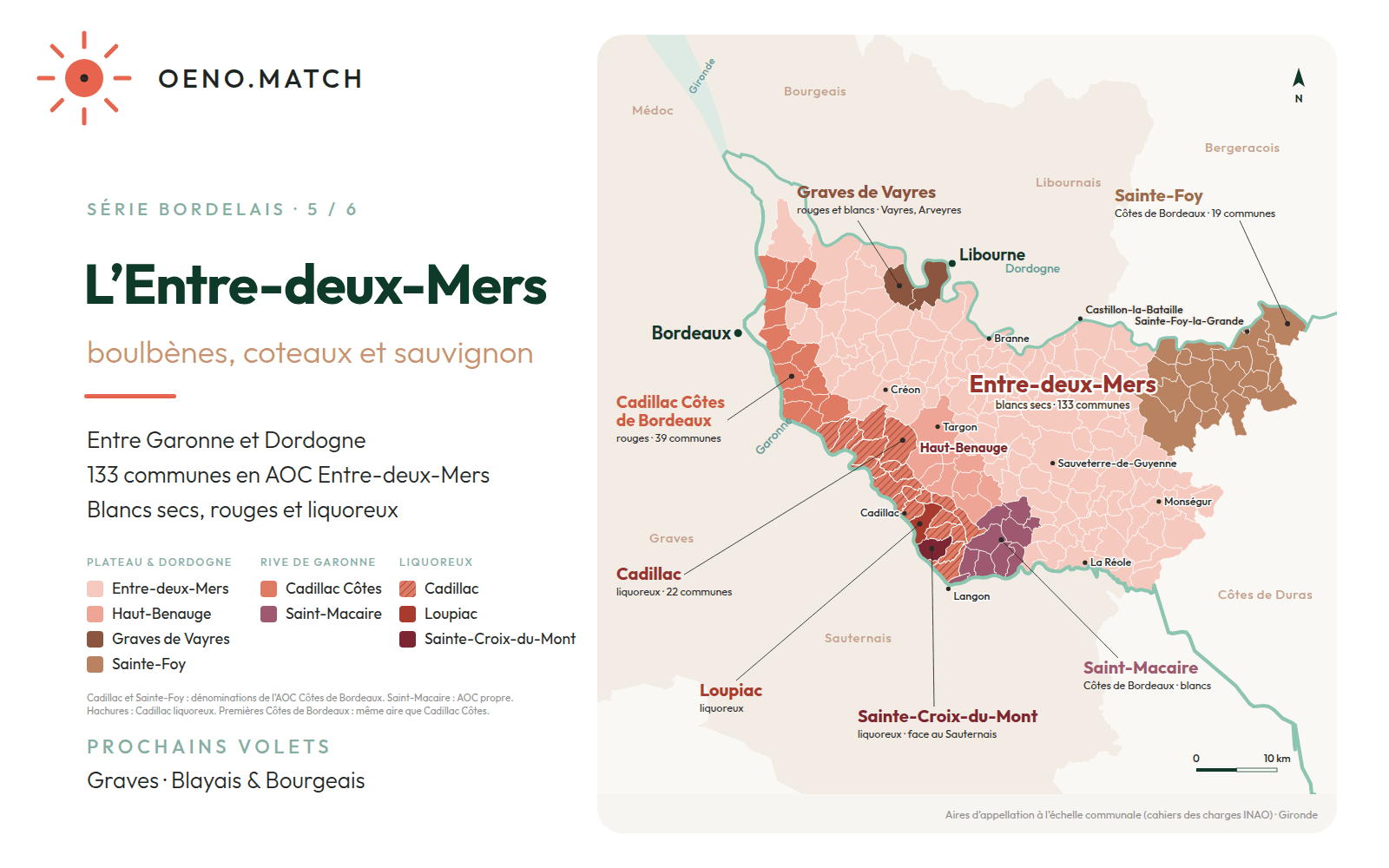
The term Entre-deux-Mers designates both a natural region and an official appellation. The appellation, in the strict sense, concerns only dry whites. But the geographic region also produces reds (60% of total production) as well as sweet whites, marketed under other labels: bordeaux, bordeaux supérieur, or under côte appellations such as cadillac-côtes-de-bordeaux, premières-côtes-de-bordeaux, or côtes-de-bordeaux-saint-macaire, which line the right bank of the Garonne. To the north, facing Fronsac, graves-de-vayres produce mainly reds and dry whites. Further east, toward Bergeracois, sainte-foy-côtes-de-bordeaux complete this difficult-to-memorize administrative patchwork for the ordinary consumer.
This mosaic of appellations is one of the region's primary challenges. Where Pomerol or Margaux benefit from a clear and immediately recognizable brand, Entre-deux-Mers presents itself in a dozen different guises depending on wine type and the commune in question.
Varied Soils, Ancient History
The limestone plateau that dominates the central zone is interspersed with valleys carved by the Dordogne, Garonne, and their tributaries. These terrain variations have shaped highly diverse terroirs: argilo-calcareous at altitude, sandier and silty in valley bottoms. This geological diversity partly explains the region's potential richness, but also the difficulty in building a unique organoleptic profile that would clearly distinguish it in buyers' eyes.
Vines have been present here since antiquity. In the Middle Ages, the region ranked among the most active in Bordeaux for exports to England, and its wines traveled along the Garonne toward ports. The great merchant houses of Libourne played a central role from the 15th century onward. Yet this historical precedence did not consolidate its prestige because mass production long took priority over distinctiveness, and cooperatives, which handle a considerable share of volumes, have durably oriented the region's image toward widely distributed wines rather than characterful cuvées.
Fruity Whites but Majority Reds
The dry white Entre-deux-Mers rests primarily on sauvignon blanc, accompanied by sémillon and muscadelle. Lively, aromatic, suited to young consumption, it enjoyed a favorable period in the 1990s when European demand for accessible dry whites developed. Today, it remains clear and well-constructed in estates that care for their viticulture, but it struggles to rival dry whites from more reputed Bordeaux terroirs.
The reds, meanwhile, are often vinified from blends of merlot, cabernet-sauvignon, cabernet franc, sometimes completed with petit verdot or malbec. They sell under the bordeaux or bordeaux supérieur appellation, without being able to claim the Entre-deux-Mers label—reserved for whites alone. This commercial paradox is not insignificant: the reds, majority in the region's actual production, have no geographic denomination of their own to defend.
Viticulturists Facing Profound Crisis
The situation of Entre-deux-Mers winegrowers fits within a difficult general Bordeaux context, but it is particularly acute there. The decline in red wine consumption in Europe, coupled with competition from New World wines in the entry-level market segment, weakens an economic model that rested on substantial volumes at contained prices. Some estates have undertaken voluntary vine uprooting, a trend affecting all of Bordeaux but weighing heavily on a zone where margins have always been narrower than elsewhere.
The most dynamic operations are betting on trading up, yield reduction, and more precise vineyard work. A few properties have also developed agritourism or direct sales to partially free themselves from merchant circuits. But transformation remains slow, and many producers continue selling their grapes to cooperatives whose brands struggle to establish themselves in export.
The real question facing Entre-deux-Mers today is less one of terroir than of legibility. A region that presents itself under ten different names, that produces mainly reds without being able to name them after itself, and whose flagship appellation designates exclusively whites: this is a difficult story to tell a Belgian or Swedish buyer with thirty seconds in front of a shelf. Solving this identity equation will probably be as decisive as any agronomic effort.