
Listen to the article
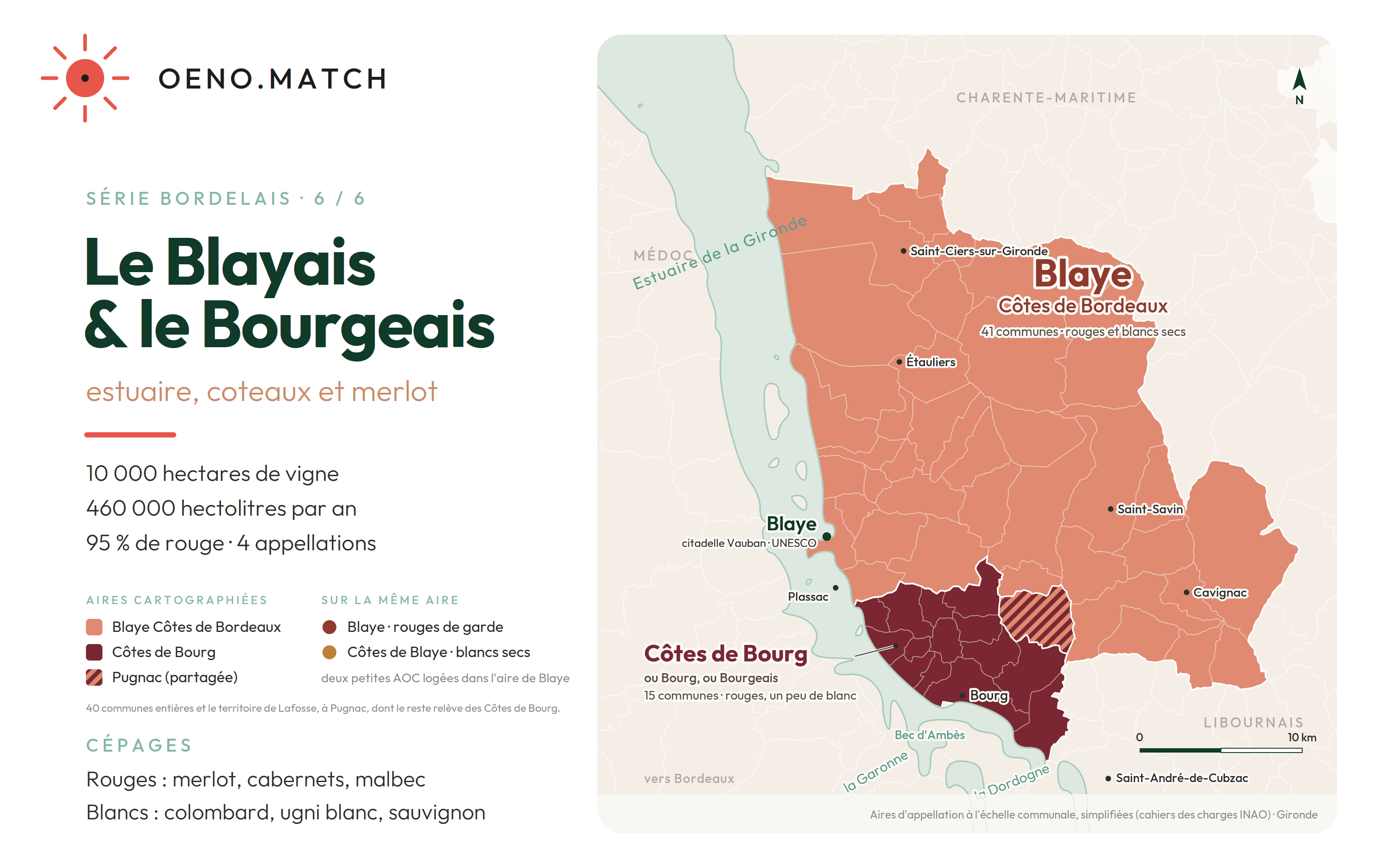
Between the Gironde estuary and the Charente hills, Blayais and Bourgeais occupy a geographical position that few enthusiasts truly know how to place. Yet this dual region produces approximately 460,000 hectolitres annually across some 10,000 hectares, with 95% red wines and the remainder dry whites. A considerable volume for a territory that still struggles to assert itself against its Libournais neighbours.
Proximity to the Gironde estuary is the structuring element of the territory. The river regulates temperatures, mitigates spring frosts, and maintains relative humidity that favours slow grape maturation. Blayais, to the north, presents diverse soils: limestone, clay-limestone and sands succeed one another according to parcels. Bourgeais, to the south, displays more homogeneous profiles, primarily clay-limestone and gravelly. The latter has indeed inherited the nickname of "little Swiss Gironde" due to its rolling hills, a relief rare in a generally flat Bordeaux. These terroir variations induce perceptible style differences between the two banks of this same geographical entity.
Merlot reigns here, as throughout the Bordeaux right bank. It comprises the dominant component of blends, accompanied by cabernet franc, cabernet-sauvignon and, notably, malbec, which retains a real place here while having largely disappeared from other Bordeaux appellations. The whites, in the minority, rely on sémillon, sauvignon blanc, muscadelle, colombard and ugni blanc.
Regarding appellations, Blayais is divided into three denominations. The blaye appellation, the most confidential, is reserved solely for red wines aged in barrel. Blaye-côtes-de-bordeaux and blaye-côte-de-bordeaux cover the bulk of production, both red and white. In Bourgeais, a single appellation exists: côtes-de-bourg, turned almost exclusively to reds, with anecdotal white production.
Existing in the shadow of Libournais, and even more so of Pomerol or Saint-Émilion, is not without economic consequences. Prices remain structurally lower, references less known to international gatekeepers, and reputation difficult to build without the support of major names. Yet this discretion has a positive flip side: it preserves a fabric of independent winemakers, often practising reasoned or organic agriculture, who work without the pressure of speculative markets. The wines that result frequently offer a quality-to-price ratio that Libournais can no longer truly propose in its flagship appellations.

Historically, Blayais preceded the rest of Bordeaux in wine commerce. The citadel of Blaye, fortified by Vauban and today listed as Unesco world heritage, controlled passage of the Gironde from the Middle Ages. Wines from the region transited through the estuary well before Bordeaux imposed its commercial dominance. This historical priority is often overlooked, even by informed enthusiasts.
What Blayais and Bourgeais have to offer is a form of Bordeaux authenticity that the left bank has progressively lost in the race for rankings. Fleshy merlots, frank malbecs, still affordable limestone terroirs: the region has no need to invent an identity. It simply needs to make it heard.