
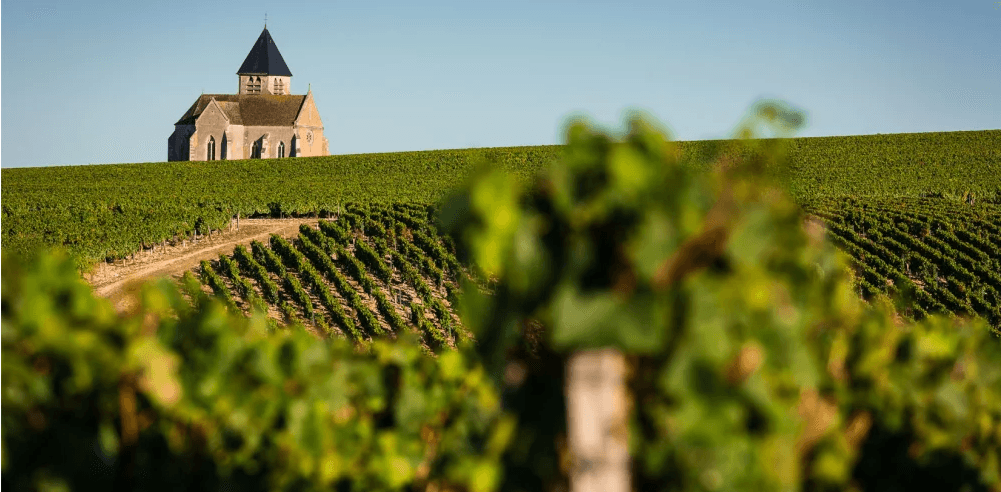
Bourgogne: at the heart of wine civilization
Bourgogne is not simply one wine region among others. It is the laboratory where wine rules have been written for a millennium. Here, terroir is not marketing poetry, but a methodical obsession: producing the best possible expression of a given plot, with a rationality that the Cistercians would have approved.
This obsession has very concrete consequences for anyone managing a cellar. Bourgogne's codes structure the European wine market. Understanding how this region works means equipping oneself with tools to navigate the wine world with greater clarity.
A geography of detail
Bourgogne is an extremely fragmented geographical construction. Between Auxerre and Mâcon, over approximately 240 kilometers, seemingly identical villages align: small churches, glazed tile roofs, limestone houses. Yet each constitutes a distinct viticultural entity.
This territorial hierarchy – regional, communal, then plot-specific (climat) appellations – is not arbitrary bureaucracy. It formalizes rigorous geological observation. The Côte-d'Or, this 50-kilometer-long escarpment, concentrates some of the world's greatest vineyards. Only a few hectares separate one great appellation from another.
For the collector, this granularity represents a formidable asset. It allows precise identification of what one seeks. It also creates an abundance of niches: there are literally hundreds of Bourgogne appellations, each with its own characteristics.
The three pillars: Pinot noir, Chardonnay, and philosophy
Bourgogne was built on two grape varieties and a single founding principle: expressing terroir rather than the producer's signature.
Pinot noir reigns supreme over the reds. This extremely demanding grape variety tolerates no mediocrity: it magnifies good terroirs but ruthlessly exposes poor practices. White Chardonnay plays a complementary role, offering broader amplitude and greater adaptability.
This varietal concentration masks a reality: Bourgogne chose difficulty. Pinot noir demands permanent technical mastery, rigorous grape selection, low yields. This is a choice only a dominant region could afford.
Côte-d'Or, Côte de Beaune, Côte de Nuits
The hierarchy is not insignificant. The Côte-d'Or divides into two distinct ensembles, separated by Beaune, a town that long served as a commercial center rather than producer.
Côte de Nuits: the domain of structured and ample Pinot noir. Gevrey-Chambertin, Vosne-Romanée, Musigny. The wines express a certain richness, concentration even in moderate vintages. This is the beating heart of red Bourgogne.
Côte de Beaune: more varied. It produces excellent Pinot noirs (Volnay, Pommard, Aloxe-Corton), but also distinguishes itself with exceptional Chardonnays (Meursault, Puligny-Montrachet, Corton-Charlemagne). Here are found the world's greatest dry whites.
Downstream from Beaune, Chardonnay gradually dominates. Chalonnaise and Maçonnais offer interesting alternatives: better value for money, more supple style, but less aging potential.
Classifying chaos: Grand Cru, Premier Cru, Village
The Bourgogne system remains impenetrable for the novice. The "Grands Crus" (Romanée-Conti, Montrachet, Musigny) constitute the apex: about 2% of the vineyard, stratospheric prices, systematic quality.
The "Premiers Crus" represent about 10% of the vineyard. They are the true discoveries: wines of great finesse, accumulating potential without the inaccessibility of Grands Crus. Here lies the best value for money for a serious cellar.
The "Appellations Communales" (designated by village name alone: Gevrey-Chambertin, Vosne-Romanée) constitute the foundation. Their quality remains remarkable, but with less consistency between producers.
Finally, regional "Bourgognes" offer a legitimate introductory approach, without excessive pretensions.
Vintage, the decisive factor
In Bourgogne, vintage is not a secondary variable. The absence of constant heat makes each year distinct. A 2015 Pinot noir and a 2016 are not comparable: one concentrated and ample, the other more elegant and nervous.
This variability creates a skill: knowing how to navigate between vintages. Warm years (2015, 2020) produce more generous wines. Cool years (2013, 2021) require restraint and reward patience with incomparable finesse.
To build a balanced cellar, one must accept this diversity rather than suffer it.
Producers: a hierarchy without official label
Unlike Bordeaux, Bourgogne does not classify its producers. A great producer can make wine from 3 hectares scattered across 5 different appellations. The prestige of the name takes precedence over the prestige of the appellation.
Domaines like Romanée-Conti, Dujac or Roumier embody excellence, but at prices that reserve them for extensive collections. Other producers offer excellent quality with more pricing restraint: this is where a cellar is truly built.
Aging potential and evolution profile
Grands Crus and Premiers Crus from Côte de Nuits age 20 to 40 years, sometimes longer. They close up a few years after bottling, then gradually open.
Pinot noirs from Côte de Beaune are more precocious: approachable between 5 and 15 years, depending on producer and vintage.
Chardonnays offer a broad spectrum: the best whites (Puligny, high-end Meursault) gain complexity over 15 to 20 years, while lighter expressions are consumed young, between 3 and 8 years.
Understanding this evolution timing is essential for the collector: it's the difference between a relevant purchase and a bottle consumed too early.
Why Bourgogne remains essential
Finally, Bourgogne commands respect not through its perfection, but through its integrity. It refuses shortcuts. No technology to compensate. No excessively concentrated grapes. One plot, one vintage, one producer – and that's all.
This economy of means creates a universe where knowledge truly has value. Those who understand Bourgogne geography, its vintages, its producers, access an understanding of wine that few regions can offer.